FIA Increases Super License Points for IndyCar Series Drivers
The motorsport world is buzzing with the recent decision by the FIA to enhance the Super License points system for drivers competing in the IndyCar Series. This change marks a significant shift in how points are allocated, and it could have far-reaching implications for drivers aspiring to secure a seat in Formula 1. The Super License, which is a prerequisite for competing in F1, ensures that drivers must earn their place through skill and performance rather than mere financial backing.
Understanding the Super License System
The Super License was established to maintain a high standard in Formula 1 racing, requiring drivers to accumulate a minimum of 40 points over a three-year timeframe. This system is designed to prevent individuals from simply buying their way into the sport, thereby maintaining the integrity and competitiveness of F1. Historically, the points system favored certain racing categories, particularly those within the FIA’s single-seater hierarchy, such as Formula 2, which has a clear pathway to F1.
Many IndyCar drivers have found themselves at a disadvantage under the previous points allocation. While they compete at a high level in a prestigious series, the points awarded for various finishing positions were not reflective of their skills or achievements. This left some talented drivers with insufficient points to qualify for a Super License, limiting their opportunities to progress to Formula 1.
New Points Allocation for IndyCar Drivers
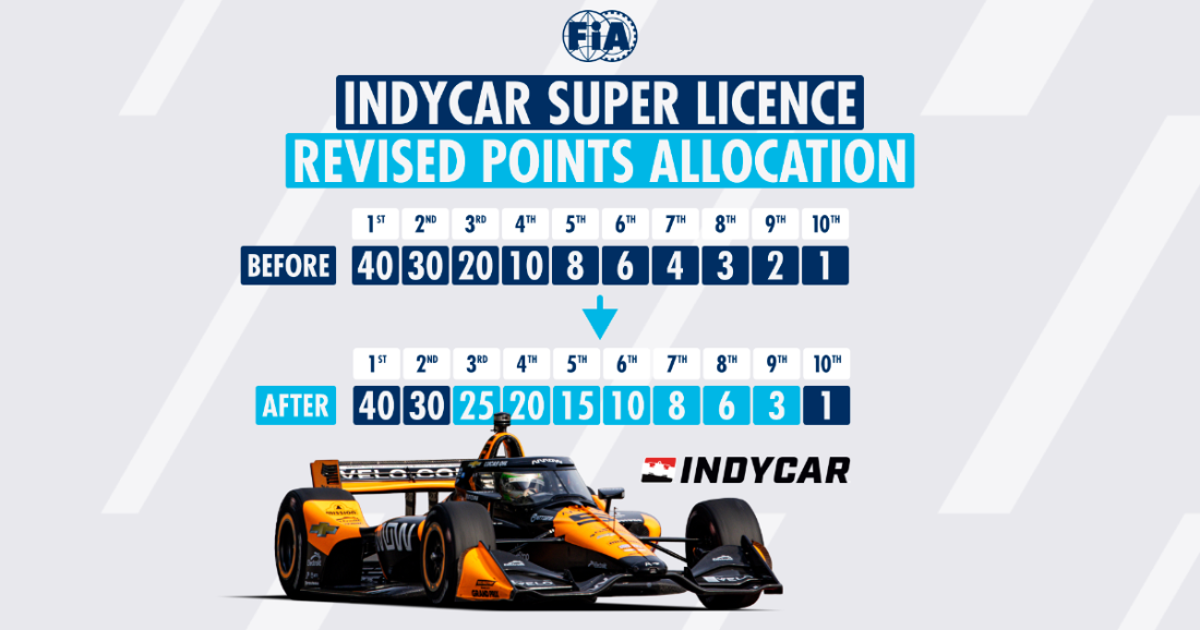
The recent decision by the FIA’s World Motor Sport Council to revise the points distribution for the IndyCar Series is a game-changer. The updated system significantly increases the points awarded for positions from third to ninth in the championship standings. This adjustment aims to acknowledge the growing importance and competitiveness of the IndyCar Series.
Under the new rules, the points for various finishing positions have been modified as follows:
- Second Place: Previously earning 30 points, this position continues to hold the same value.
- Third Place: Now, drivers finishing in third will receive 25 points, an increase from the previous allocation of 20 points.
- Fourth Place: The points awarded for this position have doubled from 10 to 20.
- Fifth Place: Drivers finishing fifth will now earn 15 points, a rise from eight.
- Sixth Place: This position has seen an increase from six points to 10 points.
- Seventh Place: Points for seventh place have doubled from four to eight.
- Eighth Place: This position now earns six points, up from three.
- Ninth Place: Drivers finishing ninth will receive three points, an increase from the previous two points.
- Tenth Place: This position remains unchanged with a single point allocated.
These changes not only enhance the points distribution for IndyCar drivers but also bring the points system closer to that of Formula 2. However, even with these adjustments, it is worth noting that the new structure would not have been sufficient for certain drivers, such as Colton Herta, to qualify for a Super License based solely on their IndyCar results.
Implications for Aspiring F1 Drivers
The increase in Super License points for IndyCar drivers opens up new avenues for those aiming to break into Formula 1. With the revised allocation, more IndyCar drivers can now realistically aspire to earn a Super License, as the new points distribution better reflects their competitive performances in the series.
Colton Herta, who has garnered significant attention for his talent, will move to Formula 2 in the upcoming season while also participating in a test role with the Cadillac F1 team. To secure his Super License, Herta needs to obtain at least six additional points. Under the new points system, he would have been just shy of the 40-point requirement, highlighting both the potential and limitations of the revised allocation.
The Growing Importance of IndyCar
The FIA’s decision to increase the Super License points for IndyCar is a testament to the series’ growing stature in the motorsport world. IndyCar has long been recognized for its thrilling races and high-caliber drivers, and this new points system acknowledges the talent and skill present in the series.
With the increased visibility and recognition, IndyCar has the potential to become a more viable pathway for drivers aspiring to compete in Formula 1. The changes encourage drivers to pursue excellence in IndyCar, knowing that their achievements could lead to opportunities in the prestigious F1 arena.
The Future of IndyCar and F1
As the lines between different racing categories continue to blur, the relationship between IndyCar and Formula 1 may evolve further. The revised Super License points system is just one example of how the FIA is responding to the changing dynamics in motorsport. By providing a more equitable points allocation, the FIA is promoting a competitive environment that encourages talent from various racing backgrounds.
IndyCar drivers now have a legitimate chance to be recognized for their skills on a global stage, and this could lead to an influx of talent transitioning from the American racing scene to the elite ranks of Formula 1. The increased points allocation also signifies a broader recognition of the importance of diverse racing disciplines and their contributions to the overall motorsport ecosystem.
Conclusion
In summary, the FIA’s decision to enhance the Super License points for IndyCar drivers marks a pivotal moment in the world of motorsport. By adjusting the points allocation, the FIA acknowledges the competitive nature of the IndyCar Series and opens new doors for drivers seeking to make their mark in Formula 1. This change not only benefits individual drivers but also strengthens the connection between different racing series, ultimately enriching the motorsport landscape as a whole.
As the motorsport community watches these developments unfold, it will be fascinating to see how they influence the careers of aspiring drivers and the future of both IndyCar and Formula 1. The journey toward achieving a Super License has become more attainable for many, and the excitement surrounding this evolution in the sport is palpable.
