The Legacy of McLaren at Brazilian Grand Prix: A Historical Overview
The Brazilian Grand Prix has always been a significant event in the Formula 1 calendar, and McLaren has played a pivotal role in shaping its history. From the winding curves of Interlagos to the flat layout of Jacarepagua, McLaren’s legacy in Brazil is rich with triumphs, challenges, and remarkable moments that continue to resonate with fans and experts alike. This article delves into the various McLaren victories at the Brazilian Grand Prix, highlighting key races and drivers that have contributed to the team’s storied presence in this South American nation.
1974: Fittipaldi’s Home Victory at Interlagos
In 1974, McLaren kicked off its season in spectacular fashion, with Denny Hulme securing a win in Buenos Aires and Emerson Fittipaldi triumphing on his home turf at Interlagos. The race at the 7.96 km track was marked by its challenging and bumpy surface, which tested the drivers and their machines. Fittipaldi’s performance was nothing short of exceptional; he secured one of only two pole positions for McLaren that year, edging out Carlos Reutemann of Brabham by a mere 0.24 seconds.
As the race unfolded, Fittipaldi found himself in a fierce battle with Ronnie Peterson from Lotus. The Brazilian driver took the lead on lap 14 after Peterson experienced a puncture. Fittipaldi maintained his lead throughout the race until a heavy downpour forced race control to display the red flag. However, an error resulted in the chequered flag being waved prematurely, allowing Fittipaldi and Ferrari’s Clay Regazzoni to complete one extra lap, securing a dramatic home victory for Fittipaldi.
1984: Lauda’s Teamwork Fuels Prost’s Win
Fast forward a decade, and the focus shifted to the flat Jacarepagua circuit in Rio de Janeiro, where McLaren made its mark yet again in 1984. The race featured a diverse field, with various constructors claiming victory in the preceding events. However, it was McLaren’s Alain Prost who emerged victorious, thanks in part to his teammate Niki Lauda’s strategic driving.
Lauda had a challenging start, qualifying seventh after struggling with an off and an engine failure. Elio de Angelis from Lotus secured pole position, but his race was cut short when he spun out due to a brake failure. Lauda quickly moved up the ranks, overtaking Derek Warwick to take the lead, which he held until an electrical failure ended his race prematurely. Despite Lauda’s setback, Prost capitalized on the situation and cruised to victory, solidifying McLaren’s reputation at the track.
1985: Prost’s Title Defense Begins
The 1985 Brazilian Grand Prix marked the beginning of Alain Prost’s first title-winning season, but it was not without its challenges. Prost qualified sixth, finding himself significantly behind pole-sitter Michele Alboreto. The race started with chaos, as Nigel Mansell from Williams went off track, allowing Prost to advance. Keke Rosberg briefly led the race until his turbocharger failed.
As Alboreto regained the lead, Prost steadily closed the gap, ultimately overtaking the Ferrari and building a commanding 28-second lead by the end of the race. This victory not only marked the start of Prost’s title defense but also showcased McLaren’s dominance in the sport.
1987: Mastering the Heat
In 1987, the Brazilian Grand Prix presented a different set of challenges for McLaren. Following a disappointing 1986 season, the team was eager to make a comeback. However, qualifying revealed a significant gap between the Williams drivers and the rest of the field, with Nigel Mansell and Nelson Piquet setting a blistering pace.
During the race, Piquet initially held the lead, thrilling the local fans. However, the extreme heat took its toll on the Williams cars, leading to overheating issues. In contrast, Prost’s McLaren, powered by a TAG Porsche engine, performed consistently, allowing him to navigate the tricky conditions and finish over 40 seconds ahead of the runner-up, Piquet. This race exemplified Prost’s exceptional racecraft and McLaren’s resilience.
1988: Prost’s Dominance Continues
The 1988 Brazilian Grand Prix saw McLaren in a league of its own, thanks to the introduction of the formidable MP4/4 powered by Honda. Ayrton Senna, known for his speed in qualifying, claimed pole position, leaving his competitors far behind. Unfortunately, Senna faced mechanical trouble that forced him to switch cars right before the race, leading to disqualification.
With Senna out of the picture, Alain Prost faced little competition and secured a convincing victory, finishing 10 seconds ahead of Ferrari’s Gerhard Berger. This race highlighted McLaren’s technological superiority and set the tone for the rest of the season.
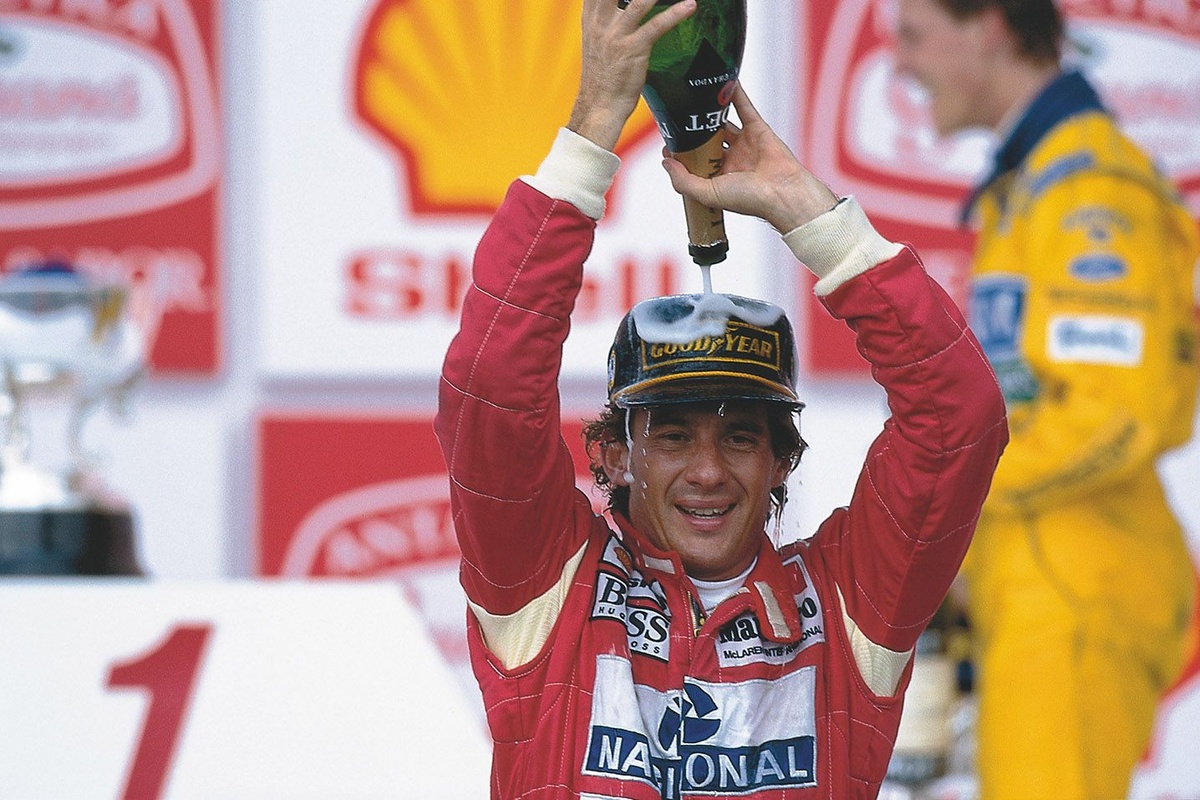
1991: Senna’s First Home Victory
After two years of Ferrari dominance in 1989 and 1990, McLaren returned to the winner’s circle in the 1991 Brazilian Grand Prix, with Ayrton Senna achieving his first home victory. Starting from pole position, Senna led the race from start to finish, showcasing his remarkable talent. However, the race was not without its challenges; Senna’s MP4/6 lost fourth gear with 20 laps remaining.
Despite this setback, Senna managed to fend off challenges from Nigel Mansell, who suffered a gearbox failure, allowing Senna to cross the finish line three seconds ahead of the competition. This victory was particularly sweet for Senna, as it marked a significant milestone in his illustrious career.
1993: Rain-Soaked Drama Unfolds
The 1993 Brazilian Grand Prix is remembered for its dramatic weather conditions and Ayrton Senna’s extraordinary performance. While the previous year had seen Senna win with relative ease, the 1993 race presented a different challenge. Qualifying third, Senna faced a significant time deficit to his rivals, Alain Prost and Damon Hill, who started ahead of him.
As the race unfolded, Senna found himself battling for position while the Williams cars pulled away. A penalty for overtaking under yellow flags further complicated his chances. However, the arrival of rain dramatically altered the race’s dynamics. Prost, misinterpreting radio messages, stayed out too long before crashing, paving the way for a thrilling duel between Senna and Hill.
In a stunning display of skill, Senna overtook Hill, securing a memorable win for McLaren and marking the team’s 100th Grand Prix victory. This race solidified Senna’s reputation as one of the greatest drivers in Formula 1 history.
1998: Hakkinen’s Grand Chelem
The 1998 season saw Mika Hakkinen assert his dominance in the Brazilian Grand Prix. Starting from pole position, Hakkinen delivered an outstanding performance, leading the race from start to finish. McLaren’s one-two finish further underscored the team’s commanding presence in the sport.
Hakkinen’s qualifying lap was a staggering 0.665 seconds faster than his teammate David Coulthard, and on race day, he showcased unmatched speed and control. The race concluded with Hakkinen finishing nearly a minute ahead of third-place driver Michael Schumacher, solidifying McLaren’s status as a dominant force in Formula 1.
1999: Hakkinen’s Tenacity
In 1999, Mika Hakkinen faced a tougher challenge in the Brazilian Grand Prix, with Michael Schumacher pushing him to the limit. Starting from pole, Hakkinen encountered mechanical issues early in the race, losing the lead to local hero Rubens Barrichello.
Despite the setback, Hakkinen demonstrated resilience, reclaiming his position after Barrichello’s retirement due to engine problems. With strategic pit stops and quick laps, Hakkinen managed to outpace Schumacher and secure another victory for McLaren, reinforcing the team’s competitive edge.
2001: Coulthard’s Fortunate Win
The 2001 Brazilian Grand Prix was a rollercoaster ride, particularly for David Coulthard. The race began with chaos as Hakkinen stalled on the grid, leaving Coulthard in a precarious position. However, when Juan Pablo Montoya took the lead, it seemed as though the race would belong to Williams.
Montoya’s misfortune struck when he was rear-ended by a backmarker, allowing Coulthard to capitalize on the situation. After a series of strategic pit stops and navigating through rain-soaked conditions, Coulthard emerged victorious, snatching victory from the jaws of defeat.
2005: McLaren’s 1-2 Finish
The 2005 Brazilian Grand Prix was a significant race for McLaren, as it concluded with a 1-2 finish, even though it did not secure the championship for the team. Juan Pablo Montoya took the lead early on, while Kimi Raikkonen surged through the pack after starting fifth. Despite the impressive performance, Fernando Alonso’s consistent driving secured him the championship title, demonstrating the competitive nature of that season.
2012: Button’s Emotional Triumph
The 2012 Brazilian Grand Prix was memorable for many reasons, not least because it marked Jenson Button’s final career victory and McLaren’s last win until the 2021 season. The race was filled with drama, beginning with a first-lap collision that threatened to derail Button’s chances. However, both McLarens started on the front row, and Button managed to navigate through the chaos.
As the race progressed, Button found himself in a heated battle for the lead. When a series of incidents unfolded,
