Analysis of the Controversial Start at the Mexico Grand Prix
The Mexico Grand Prix at the Autódromo Hermanos Rodríguez has always been a thrilling event, but the latest race sparked significant debate among drivers, pundits, and fans alike. A key point of contention was the actions of Red Bull Racing’s Max Verstappen during the early laps of the race. As the race unfolded, many were left questioning whether Verstappen’s maneuvers warranted a penalty, and if so, what kind of precedent this would set for future races.
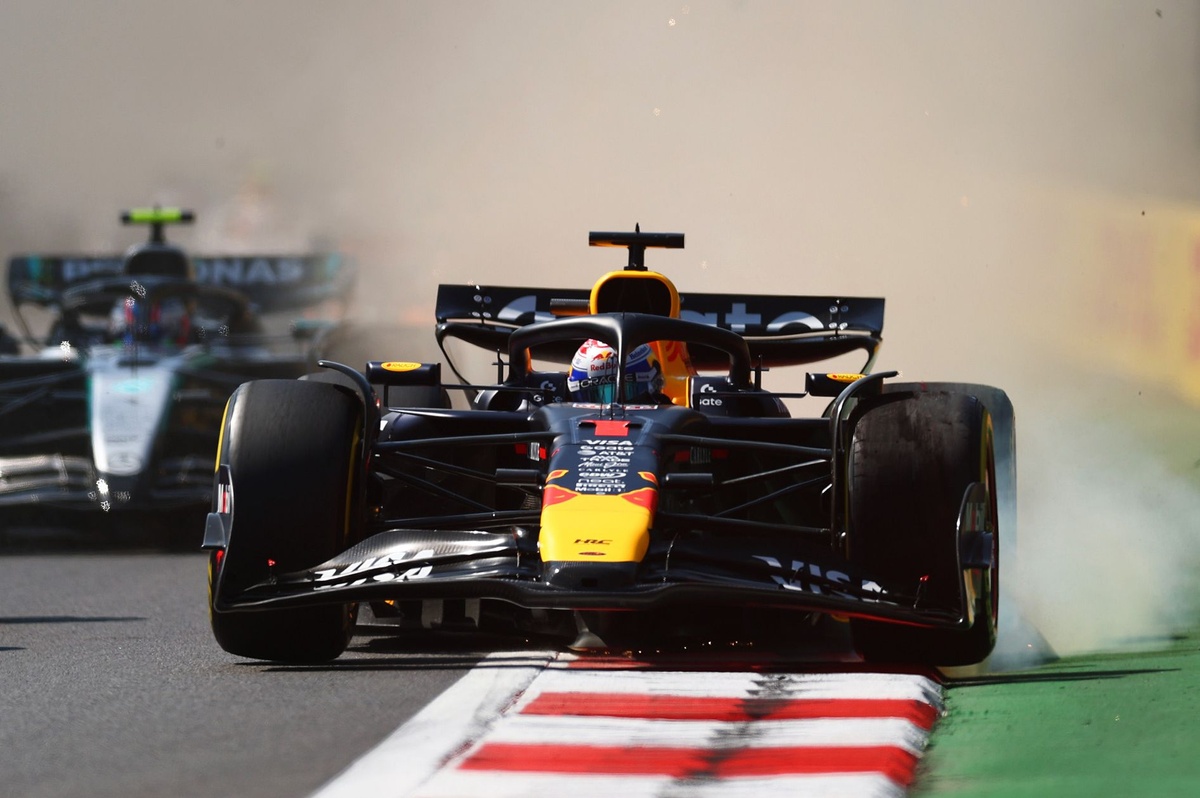
The Incident at Turn 1-2-3
As the race commenced, Verstappen found himself in a precarious position on the outside of the track, jockeying for position against polesitter Lando Norris and both Ferrari drivers. As the cars approached the first braking zone, Verstappen locked up, realizing he was overshooting the corner. Rather than braking, he opted to drive straight through the exit of Turn 3, rejoining the race in third place.
This bold move raised eyebrows, particularly from former Formula 1 driver Martin Brundle, who argued that Verstappen should have received a drive-through penalty for his actions. Brundle’s perspective stemmed from the belief that Verstappen’s decision to cut the corner contradicted the essence of racing fairness. “Max should have had a penalty,” Brundle stated on the F1 Show podcast. He emphasized that by positioning his car on the far-left side of the track and accelerating off the curb, Verstappen essentially bypassed the standard racing protocol.
Brundle’s Perspective on Penalties
Brundle was particularly vocal about the need for penalties to discourage reckless driving. He proposed that a drive-through penalty could serve as a deterrent for future incidents involving corner-cutting. His assertion highlighted a growing concern among drivers and officials regarding the lack of accountability for aggressive racing tactics. “You can see Max actually accelerate—really skillful driving through the grass, I must say—but Max made no effort whatsoever to take Turns 1, 2, or 3. And that should have been a penalty,” Brundle reiterated.
Brundle’s emphasis on the importance of maintaining racing standards resonated with many fans and pundits who felt that rules should be enforced consistently. The fear is that without consequences, drivers might feel encouraged to take similar risks, leading to chaotic situations.
Villeneuve’s Contrasting View
Adding to the debate, 1997 Formula 1 World Champion Jacques Villeneuve offered a different viewpoint. He argued that while Verstappen’s actions may have appeared questionable, they did not technically breach the rules. Villeneuve pointed out that Verstappen was ahead of George Russell at the time, which meant he had the right to rejoin the race as he did.
“The thing is, intent is one thing, and we cannot really put intent in the rules; it’s difficult,” Villeneuve explained. He acknowledged that although Verstappen’s actions may not have aligned with the spirit of racing, they conformed to the existing regulations. This dichotomy between what is right and what is legal complicates the decision-making process for race officials.
The Dilemma of Rule Enforcement
This leads to a larger dilemma within Formula 1: the challenge of enforcing rules that are often ambiguously written. Villeneuve articulated this concern, stating, “By the rules, he was ahead of George [Russell], so by the rules, it didn’t deserve a penalty. By the action, yes.” This complexity creates a gray area that drivers and teams must navigate, often leading to disputes and dissatisfaction among competitors.
In the case of Verstappen, his calculated risk paid off, as he managed to avoid a penalty and continue competing for the championship. However, Villeneuve warned that such a lenient interpretation of the rules could lead to further complications down the line. “He knew it was worth taking a risk because whatever, just step on the gas and go through,” he noted.
Leclerc’s Similar Situation
The drama didn’t end with Verstappen. Ferrari’s Charles Leclerc found himself in a similar predicament as he approached Turn 1. Although he was granted space by his teammate, Leclerc opted to cut Turn 2 entirely, emerging in the lead. Unlike Verstappen, who ultimately let Hamilton pass, Leclerc retained his position over the seven-time world champion.
Brundle was critical of Leclerc’s maneuver as well, suggesting that he should have received a penalty for cutting the corner. “For me, at least Charles made an attempt at Turn 1, didn’t like the look of the way it was shaping up, so just ignored Turn 2—and that, for me, was also a 10-second penalty,” he asserted.
Villeneuve echoed this sentiment, indicating that Leclerc’s decision to accelerate instead of attempting the corner illustrated a lack of respect for the rules of racing. “Leclerc, yes, because he was actually behind Lewis. He didn’t even try to make the corner,” Villeneuve stated.
The Broader Implications of Cutting Corners
The incidents at the start of the Mexico Grand Prix have broader implications for the sport. The drivers’ decisions to cut corners raise questions about the safety and integrity of racing. Villeneuve pointed out that if the track had gravel or walls instead of asphalt run-offs, the drivers would be less inclined to take such risks. “If you have gravel there or a wall, you wouldn’t be four-wide,” he explained.
This line of thinking reflects a growing concern among drivers about the nature of modern racing circuits. Many feel that the designs of contemporary tracks facilitate aggressive driving tactics, allowing cars to bypass corners without meaningful consequences. The result is often chaotic racing and a lack of accountability.
Drivers’ Reactions
The reactions from drivers following the race highlighted the frustration felt by many. George Russell, who finished fifth, criticized the driving standards of his competitors, likening it to “lawnmower racing.” His frustration was echoed by veteran Fernando Alonso, who suggested that he too might start cutting corners if they continued to go unpunished.
Brundle emphasized the growing discontent among drivers who adhere to the rules while watching their peers gain advantages through corner-cutting. “I completely can understand those drivers—who were minding their business actually staying on the racetrack—going like, ‘Well, hang on, I’m losing out here. I might as well just make my own racetrack up in the first few corners and gain some places,’” he noted.
Verstappen and Leclerc’s Podium Finishes
Despite the controversies surrounding their actions, both Verstappen and Leclerc managed to secure podium finishes in Mexico. For Verstappen, this result was crucial in his ongoing championship battle, with his deficit to the points leader, Lando Norris, reduced to just 36 points. The outcome leaves fans and analysts pondering the implications of the race on the championship and the standards of racing moving forward.
The Need for Clarity in Racing Regulations
Ultimately, the events of the Mexico Grand Prix underline a pressing need for clarity and consistency in Formula 1’s regulations. As the sport evolves, so too must the rules governing it. The challenge lies in finding the balance between allowing drivers the freedom to race competitively while also ensuring that they adhere to the principles of fair competition.
The controversies from the Mexico Grand Prix serve as a reminder that the world of Formula 1 is complex, filled with both exhilarating moments and difficult discussions. As teams and drivers prepare for future races, the lessons learned from this event will undoubtedly influence the ongoing dialogue about racing regulations, accountability, and what it truly means to compete at the highest level of motorsport.
In conclusion, the start of the Mexico Grand Prix encapsulated the ongoing struggle between aggressive racing tactics and adherence to the rules. As discussions continue, the hope is that the sport will move towards a more equitable system that upholds the spirit of competition while also ensuring that all participants are held to the same standard. The road ahead may be fraught with challenges, but it is one that the Formula 1 community must navigate together.
