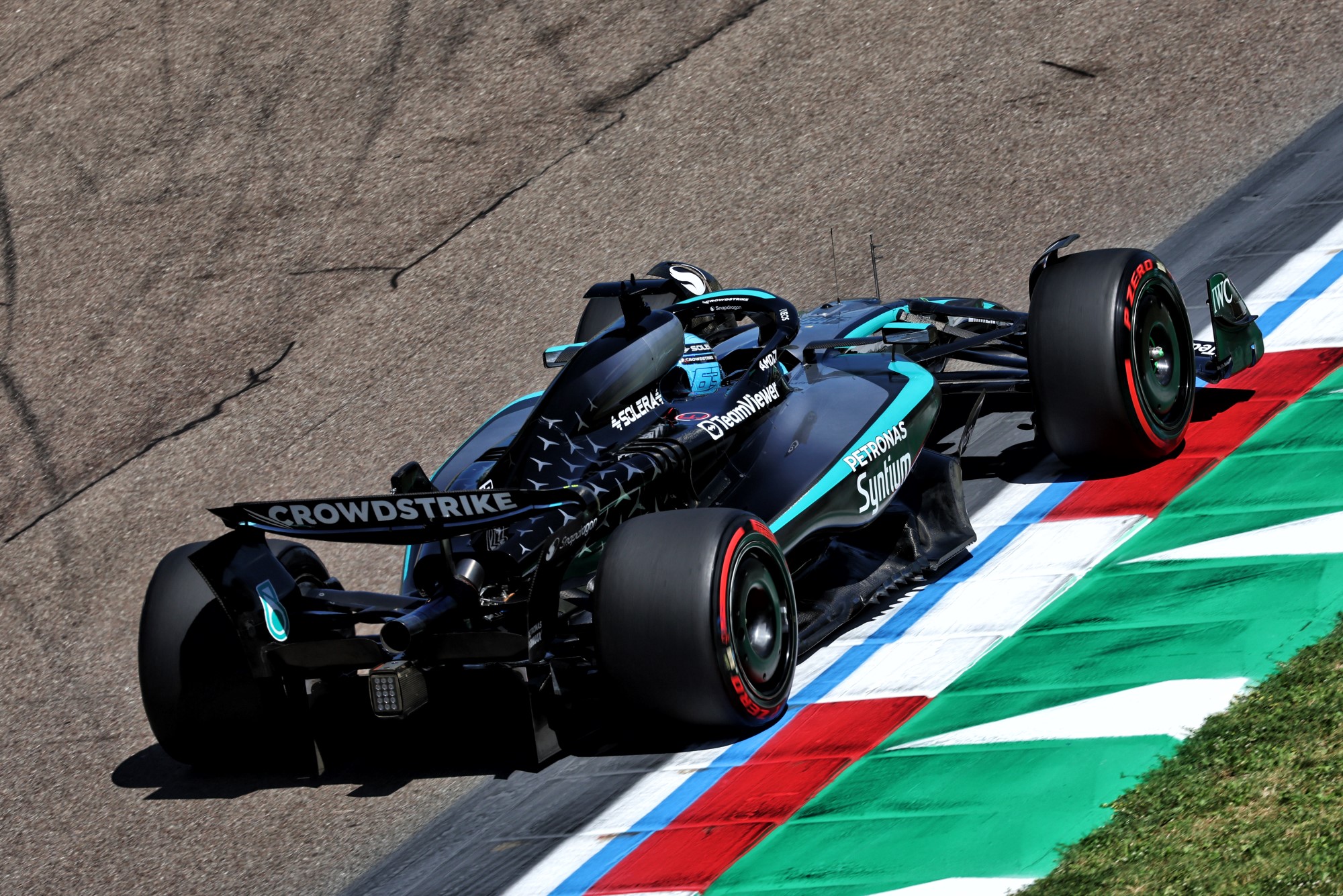
George Russell’s Challenging Weekend at the Emilia-Romagna Grand Prix
George Russell faced a tough race during the Emilia-Romagna Grand Prix, where it became evident that his Mercedes car was not performing as expected. The British driver reported feelings of potential issues with his car, noting that the team had been outpaced by competitors who he described as having delivered a "semi-decent" performance throughout the race weekend.
As the race progressed, Russell communicated via radio that he suspected something was amiss in the rear of his vehicle. However, the Mercedes team reassured him that their telemetry and sensor data did not indicate any anomalies. "It felt like my rear wheels were shifting laterally," Russell explained to the media after the race in Imola. He highlighted that even in straight lines, the car exhibited unusual movement, and the rear tires were overheating.
Russell’s assessment suggested that the performance of his car was subpar, which allowed competitors to surpass Mercedes on the track. He observed that the team had a fundamental issue that affected tire performance, noting that either the front or rear tires would overheat, depending on the circuit conditions. This recurring issue has plagued the team for some time, resulting in a lack of competitiveness compared to their rivals. "This isn’t the first year we’ve faced this problem. It’s clear that we have a weaker performance than our competitors," he admitted.
Reflecting on the overall race weekend, Russell emphasized that many top teams, including Red Bull, Ferrari, and Mercedes, have experienced disappointing weekends at some point during the season. He pointed out that this time, it was Mercedes’ turn to face challenges. "The reality is that every team has a disastrous race weekend at some point. Red Bull had theirs in Bahrain. This is our first of the year, and while I’m not thrilled about it, it’s important to remember that not every race will see you on the podium week after week," Russell concluded after finishing the race in seventh position.
Understanding the Challenges of Formula 1
Formula 1 is a sport characterized by its high-speed thrills, cutting-edge technology, and intense competition. Each race presents a unique set of challenges that can dramatically affect a team’s performance. From aerodynamic efficiency to tire management, every aspect of the car’s design and setup plays a crucial role in achieving success on the track.
In the case of George Russell and the Mercedes team, the Emilia-Romagna Grand Prix highlighted several critical factors. The balance of the car, tire performance, and driver feedback are all interlinked components that can determine the outcome of a race. When a car feels unstable or inconsistent, it can significantly impact the driver’s confidence and overall performance.
Tire Management in Formula 1
One of the most vital aspects of Formula 1 racing is tire management. Each team must carefully select the tire compounds that best suit the track conditions and their car’s characteristics. Inconsistent tire performance can lead to overheating, reduced grip, and ultimately slower lap times. Russell’s comments about the overheating tires illustrate the importance of this element in the sport.
Tires are designed to operate within specific temperature ranges to provide optimal performance. When a tire exceeds its ideal temperature, it can lose grip and wear more quickly, leading to a decline in performance. The ability to manage tire temperatures effectively is crucial for success, as teams strive to maximize their performance over the duration of the race.
The Role of Aerodynamics
Aerodynamics plays a significant role in a Formula 1 car’s performance. The design of the car, including its shape and the placement of various components, impacts how air flows around it. A well-designed aerodynamic package can enhance downforce, allowing the car to maintain stability at high speeds. Conversely, poor aerodynamic performance can lead to instability, as Russell experienced during the Emilia-Romagna Grand Prix.
When a car’s aerodynamics are not functioning optimally, it can result in a lack of grip and unpredictable handling. This issue can be particularly pronounced in corners, where the car’s ability to maintain contact with the track is crucial for speed and control. Russell’s description of his rear wheels moving laterally suggests that aerodynamic issues may have contributed to the instability he felt during the race.
Team Dynamics and Communication
Effective communication between drivers and their teams is essential in Formula 1. Drivers rely on their teams to provide real-time information about the car’s performance, track conditions, and strategic decisions. In Russell’s case, he communicated his concerns about the car’s handling to the Mercedes team, who responded with telemetry data indicating no significant issues.
This dynamic illustrates the importance of trust and collaboration within a racing team. Drivers must feel confident that their teams are providing accurate assessments of the car’s performance. When discrepancies arise between a driver’s experience and the team’s data, it can create frustration and uncertainty.
The Competitive Landscape of Formula 1
Formula 1 is known for its fierce competition, with multiple teams vying for supremacy on the track. The current landscape features several strong contenders, including Red Bull, Ferrari, and Mercedes. Each team brings its unique strengths and weaknesses, making every race a battle for supremacy.
As Russell pointed out, even the top teams experience challenging weekends. The competitive nature of the sport means that no team can afford to be complacent. A single poor performance can have significant implications for a team’s standings in the championship. For Mercedes, the Emilia-Romagna Grand Prix served as a reminder of the need for continuous improvement and adaptation to stay competitive.
Looking Ahead
As the season progresses, the Mercedes team will undoubtedly analyze the challenges faced during the Emilia-Romagna Grand Prix. Identifying and addressing the issues with tire performance and aerodynamics will be crucial for regaining their competitive edge. Russell’s feedback will play a vital role in shaping the team’s approach as they work to enhance the car’s performance for future races.
In the world of Formula 1, the pursuit of excellence is an ongoing journey. Teams must remain agile and responsive to the ever-changing dynamics of the sport. As drivers like George Russell navigate the highs and lows of racing, their experiences contribute to the evolution of their teams and the sport as a whole.
In conclusion, George Russell’s experience during the Emilia-Romagna Grand Prix serves as a microcosm of the challenges faced in Formula 1. From tire management to aerodynamics and team dynamics, every aspect of the sport is interconnected. As the season unfolds, the Mercedes team will be focused on overcoming obstacles and striving for improved performances on the racetrack. The competitive spirit of Formula 1 ensures that fans can expect thrilling races and intense battles as teams work tirelessly to achieve success.
