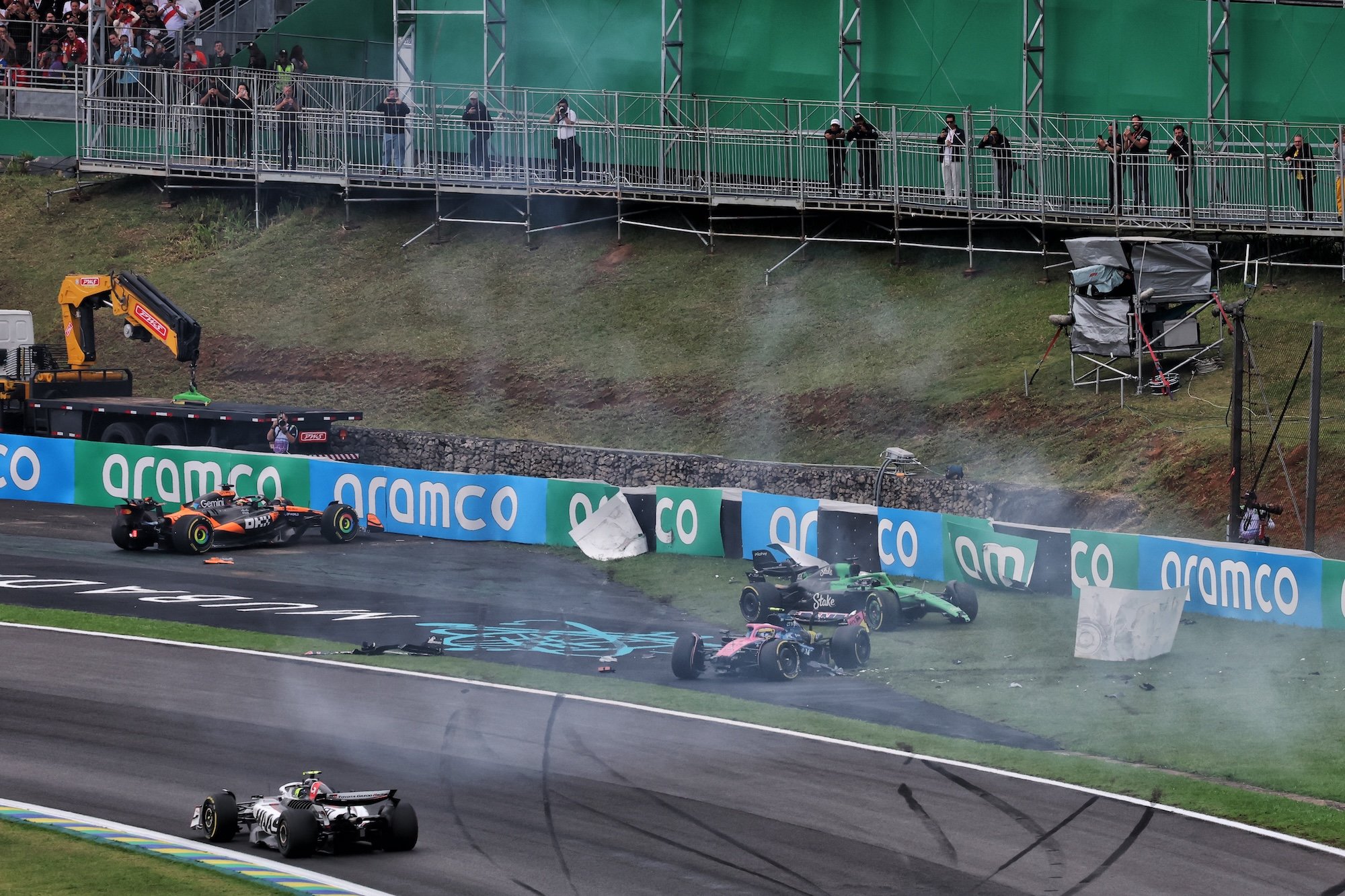
Analyzing Oscar Piastri’s Incident at the São Paulo Sprint Race: Insights from Jolyon Palmer
In the world of Formula 1, every race provides an opportunity for drivers to showcase their skills, and the recent Sprint Race at the São Paulo Grand Prix was no exception. Former F1 driver and current commentator Jolyon Palmer offered a detailed assessment of an incident involving Oscar Piastri, highlighting the stark difference between Piastri’s mishap and Max Verstappen’s adept handling of similar circumstances.
The Sprint Race’s Challenging Conditions
The São Paulo Sprint Race was marked by challenging weather conditions that tested the drivers’ abilities to navigate the circuit effectively. Parts of the Interlagos track were wet while other sections had dried out, creating a complex racing environment. One of the most treacherous areas was the entrance to Turn 3. Here, water had pooled on the inside curb, which posed a significant risk to drivers attempting to maintain their speed while cornering.
This unpredictability was evident as Lando Norris managed to navigate through this tricky section without any issues, even though he raised a spray of water that almost caught Kimi Antonelli off guard. In contrast, Oscar Piastri struggled to maintain control of his McLaren, resulting in a crash that forced him to retire from the race. Following Piastri’s incident, both Nico Hulkenberg and Franco Colapinto also encountered difficulties at the same spot, highlighting how the conditions could catch even the most skilled drivers off guard.
Palmer’s Perspective on the Incident
Palmer emphasized that the incident served as a "test of skill" for the drivers involved. He noted that it was a pivotal moment to see who could keep their car on the track under pressure. Palmer remarked, “It’s a test of skill. Can you keep the car on the track?” This statement underscores the critical nature of precision in Formula 1 racing, especially under less-than-ideal conditions.
What made the situation even more telling was Verstappen’s ability to successfully navigate through the same challenging turn that Piastri could not. Palmer pointed out that the differences between drivers can often come down to mere millimeters, which can significantly impact the outcome of a race. “The absolute level of skill matters. The reactions and control of the car are everything,” Palmer added, highlighting the fine line that separates success from failure in high-stakes racing.
Max Verstappen’s Skill Under Pressure
During the race, Verstappen faced the same dilemma as Piastri, with the added pressure of being a top contender. Palmer described how Verstappen encountered the same slippery conditions but managed to react in time, thus avoiding a collision. “Verstappen also went over that curb and had a big scare. He almost became the first to follow Piastri into the wall, but he managed to control it,” Palmer explained.
This incident serves as an illustration of Verstappen’s natural talent and his exceptional ability to maintain control over his vehicle, even in the face of adversity. Palmer’s comments reflect a broader understanding of how premier drivers operate at the highest levels of motorsport, where split-second decisions can lead to vastly different outcomes.
The Consequences for Piastri
For Piastri, the repercussions of this incident were significant. Prior to the race, he was just a point behind his teammate Lando Norris in the championship standings. However, following his crash, Piastri found himself trailing by 24 points. Additionally, he faced a ten-second penalty for a separate incident involving Antonelli during the main Grand Prix, compounding the challenges he faced over the weekend.
This series of events marks a concerning trend for Piastri, who has not seen the podium since the Italian Grand Prix in September. As the season progresses, he finds himself in a difficult position, with Norris increasingly in contention for the championship title. The pressure is mounting, and Piastri’s ability to rebound from this setback will be critical in the remaining races.
The Importance of Skill and Experience
The incidents during the São Paulo Sprint Race highlight the importance of skill and experience in Formula 1 racing. While young talents like Piastri show promise, the ability to handle pressure and navigate tricky conditions is often what separates the best from the rest. Verstappen’s experience and skill allowed him to avoid disaster, while Piastri’s inexperience in such high-stakes situations led to a costly error.
In motorsport, especially at the level of Formula 1, the margin for error is incredibly slim. Drivers must constantly adapt, learn, and improve their skills to remain competitive. This weekend’s events serve as a reminder of the rigorous demands of the sport, where mental fortitude and technical prowess are essential for success.
Navigating the Challenges Ahead
As the F1 season unfolds, drivers like Piastri must learn from their experiences and adapt to the challenges that lie ahead. The São Paulo incident is not just a lesson in handling a car in wet conditions; it is a reminder of the need for continuous growth and development in a sport where every race is a chance to prove oneself.
For Piastri, the road ahead will require resilience and determination. He must refine his skills, learn from his mistakes, and approach future races with a renewed sense of focus. The competition is fierce, and with seasoned drivers like Verstappen setting the standard, the pressure on younger drivers to perform is greater than ever.
The Future of Formula 1
Looking ahead, the dynamics of Formula 1 are ever-evolving. With young talents entering the sport and seasoned veterans continuing to dominate, the competition remains fierce. Piastri’s journey is just one of many stories unfolding within the sport, each race providing a new chapter filled with excitement, challenges, and opportunities for growth.
As fans of Formula 1, we can expect to see more thrilling races, unexpected twists, and moments of brilliance from drivers as they navigate the complexities of the sport. Each race weekend serves as a reminder of the skill, dedication, and passion required to excel at the highest level of motorsport.
The lessons learned on the track are invaluable not only for the drivers but for everyone involved in the sport. Whether it’s the teams, engineers, or fans, the shared experience of witnessing the highs and lows of racing fosters a deep connection to the world of Formula 1.
Conclusion
The recent incidents during the São Paulo Sprint Race have shed light on the intricate balance between skill, experience, and the unpredictable nature of racing. With each race, drivers like Piastri have the opportunity to learn and evolve, striving for excellence in a sport that demands nothing less. As the season progresses, the anticipation builds for what lies ahead, with every lap offering a new chance for drivers to showcase their talents on the grand stage of Formula 1.
