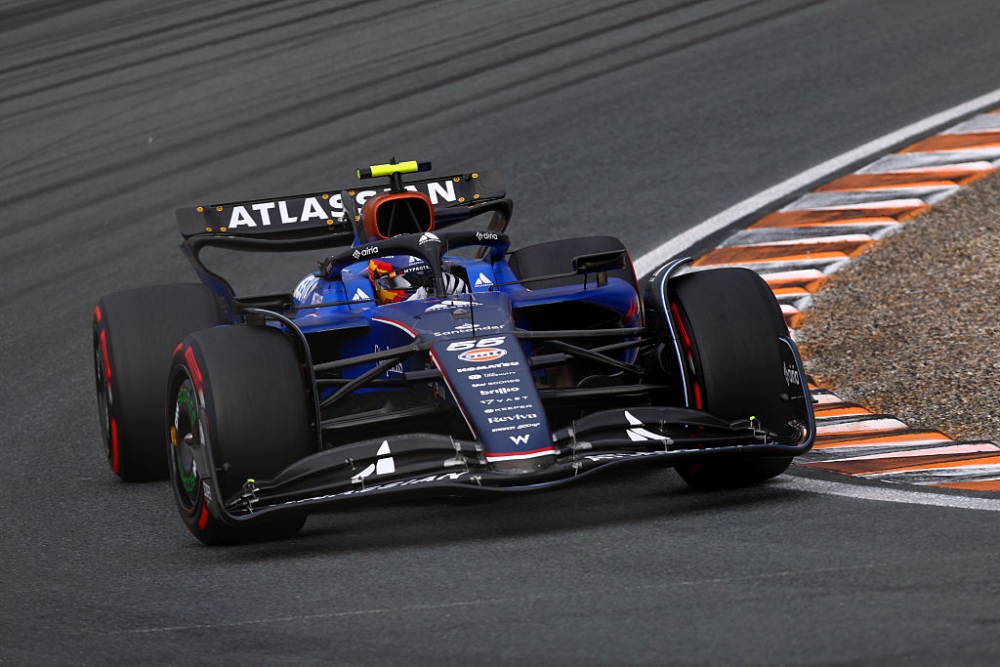
Williams Successfully Challenges Carlos Sainz’s Penalty at Dutch Grand Prix
In a notable turn of events in the world of Formula 1, Williams Racing has effectively challenged the penalty imposed on Carlos Sainz during the recent Dutch Grand Prix. This incident, which occurred during a race filled with high stakes and intense competition, involved a collision between Sainz and fellow driver Liam Lawson. Initially, Sainz faced a 10-second time penalty along with two penalty points on his racing license due to the collision, which resulted in both drivers sustaining punctured tires.
The incident unfolded at the Zandvoort circuit when Sainz’s right front tire made contact with Lawson’s left rear tire near the exit of Turn 1. Following the race, Sainz expressed his dissatisfaction over the radio and in post-race interviews, indicating his intention to discuss the ruling with the stewards. Williams Racing, taking a proactive stance, announced that they would seek to have the penalty reviewed by providing new evidence that could cast doubt on the original decision.
The Request for Review
During the Italian Grand Prix weekend, Williams confirmed that they had submitted a formal request for the right to review the incident that led to Sainz’s penalty. To proceed with this request, they were required to present new, relevant, and significant evidence that could justify a re-evaluation of the penalty. This requirement set the stage for a crucial hearing that took place the following Friday.
The stewards, upon reviewing the case, acknowledged that Williams had met the necessary threshold to warrant a review. The team was able to provide new camera footage: a 360-degree view from Sainz’s car and a rear-facing camera from Lawson’s vehicle. These angles had not been available during the original decision, and the stewards deemed this footage as pivotal to the reassessment of the incident.
The Hearing and Arguments Presented
During the hearing, Williams representatives articulated their position, arguing that the incident should be classified as a racing incident rather than a fault solely attributable to Sainz. They contended that Lawson had experienced a momentary loss of control mid-corner, which ultimately led to the collision. It was emphasized that while Sainz’s actions had contributed to the incident—by choosing to drive close to Lawson’s car—no driver should be considered predominantly at fault.
The stewards were clear in their assessment, indicating that they did not find Sainz’s testimony to be a necessary factor in their decision-making process. They maintained that their authority allowed them to render judgments based on the evidence available without requiring a driver’s account of the incident. Nevertheless, the newly presented camera angles were instrumental in facilitating the review.
The Decision and Its Implications
After deliberation, the stewards concluded that the collision stemmed from Lawson’s temporary loss of control, which was the primary cause of the incident. They noted that although Sainz had taken a risk by positioning his car close to Lawson’s, the circumstances did not warrant a penalty for either driver. The stewards clarified that both drivers contributed to the incident but did not hold either one predominantly responsible.
While the 10-second time penalty that Sainz had served during the race could not be erased, its impact was minimal, given that he finished the race 17 seconds behind Lawson, who had also experienced a challenging outing. Importantly, the two penalty points that had been added to Sainz’s license were rescinded, allowing him to maintain a clean slate.
In response to the outcome, Williams Racing released a statement expressing their gratitude to the stewards for reconsidering the penalty. They acknowledged the frustration stemming from the initial decision, which had compromised their race. The team emphasized their commitment to collaborating constructively with the FIA to enhance stewarding processes and refine racing regulations moving forward.
The Broader Context of Stewarding in Formula 1
The incident involving Carlos Sainz and Liam Lawson highlights the complexities and challenges that come with stewarding in Formula 1. The decision-making process for penalties can often be contentious and subject to interpretation. As teams and drivers push the limits of racing, the potential for incidents increases, necessitating a robust and fair review process.
In recent years, there have been calls within the motorsport community for improved transparency and consistency in stewarding decisions. The ability for teams to present new evidence and have decisions reviewed is a step in the right direction. It allows for a more nuanced understanding of incidents, where the context and specific circumstances can be evaluated more thoroughly.
Additionally, the use of advanced technology, such as the 360-degree camera footage utilized in this case, represents a significant advancement in how incidents are assessed. This technology provides a more comprehensive view of the racing dynamics at play, allowing stewards to make more informed decisions that reflect the realities of high-speed racing.
The Future of Racing Incidents and Penalties
As Formula 1 continues to evolve, the handling of racing incidents and penalties will likely remain a focal point of discussion. Teams, drivers, and fans alike will be keenly observing how the FIA implements changes to improve the stewarding process. The incident involving Sainz and Lawson serves as a reminder of the need for adaptability within the sport, as well as the importance of balancing safety with competitive integrity.
Furthermore, the race for championship points and positions adds an extra layer of intensity to every on-track battle. Drivers are constantly navigating the fine line between aggressive racing and the risk of penalties. As the sport strives for excellence, the ways in which it addresses racing incidents will play a crucial role in shaping the experience for teams, drivers, and fans.
In conclusion, while the outcome of the hearing provided relief for Carlos Sainz and Williams Racing, it also underscored the ongoing challenges of stewarding in Formula 1. The collaborative efforts between teams and the FIA to refine processes and enhance the clarity of regulations will be vital in ensuring that the sport continues to uphold its commitment to fairness and competitiveness. As the season progresses, all eyes will be on how these developments unfold and influence the future of racing in Formula 1.
