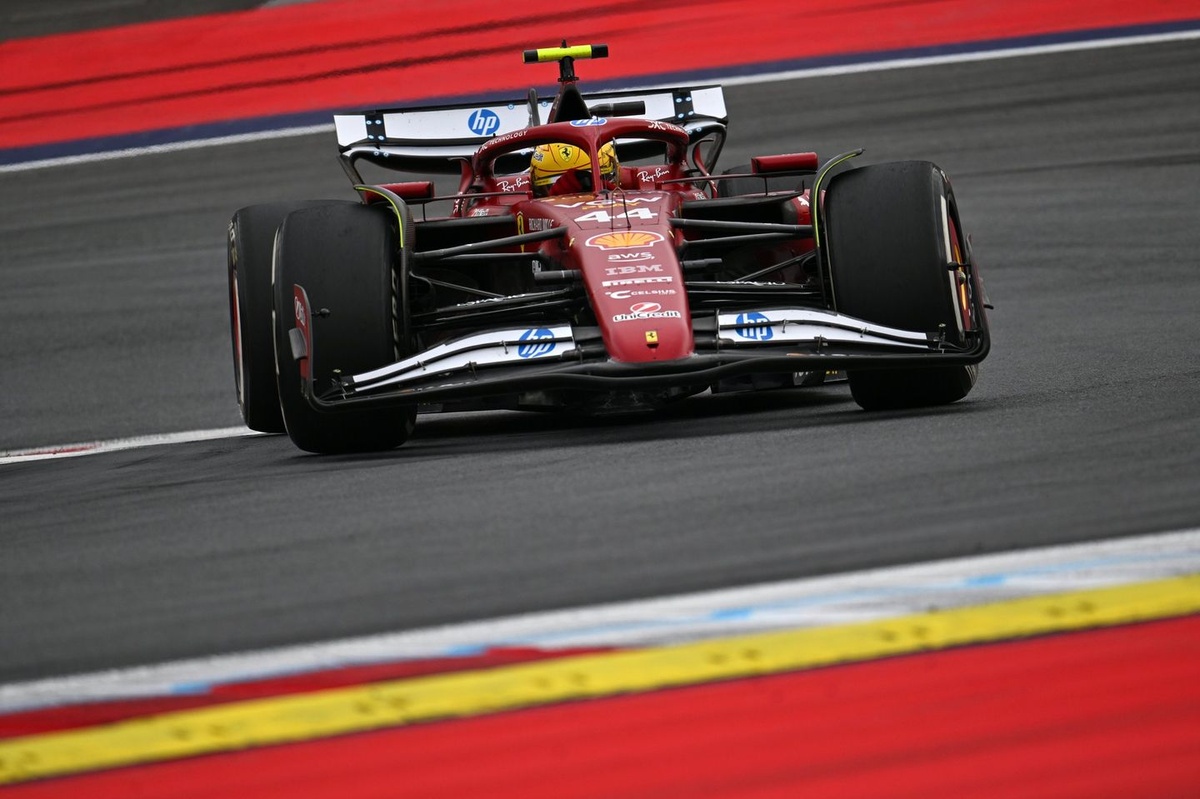
Ferrari’s New Floor Design: Insights from the Austrian Grand Prix
The atmosphere was charged with anticipation as Ferrari introduced their newly engineered floor design during the Formula 1 Austrian Grand Prix at the Red Bull Ring. Both Lewis Hamilton and Charles Leclerc approached the race weekend with cautious optimism, despite their initial assessments suggesting the new components may not significantly enhance their performance on the track.
A Comprehensive Update to the Floor Design
Ferrari’s revamped floor brought several crucial changes, including modifications to the body, edges, and the floor wing, alongside a redesigned diffuser. These alterations were strategically aimed at improving the aerodynamic load across various cornering speeds, with the intention of creating a performance advantage in diverse track conditions. The team’s engineers worked meticulously to ensure that the new design would respond effectively to the challenges of the circuit.
Friday’s Practice Sessions: A Mixed Bag
The first day of practice, often a crucial time for teams to gauge their car’s performance, proved to be somewhat underwhelming for Ferrari. Charles Leclerc, in particular, demonstrated potential during long run sessions, yet his lap times fell short of expectations. He recorded a time that placed him six-tenths of a second behind Lando Norris, the leader of FP2, largely due to struggles with cornering speeds in the fast left-hand turns of the Red Bull Ring.
Hamilton faced his own challenges, clocking in three-tenths slower than Leclerc. While he excelled in traction zones exiting slower corners, he too lost precious time elsewhere on the track. The day’s practice sessions were not entirely standard for either driver. Leclerc skipped FP1 to allow rookie Dino Beganovic some track time, while Hamilton dealt with gearbox issues that hampered his performance in longer runs.
Leclerc’s Perspective on the New Floor
Despite the challenges, Leclerc remained hopeful, downplaying the impact of his reduced track time in FP1. He noted that he felt comfortable immediately during FP2, although he struggled with the car’s overall feel. "There’s still a lot of work to be done for tomorrow," he stated, acknowledging that the car’s performance was not yet up to par. He added, "Long runs seem to be more positive. We were very similar to the fastest guys, but the problem is that everything is so close that starting from P6 or P7 makes it extremely difficult to make up ground during the race."
Leclerc expressed a level of satisfaction with the new floor’s aerodynamic figures but admitted that feeling the difference on the track was challenging. "It’s very difficult for me to make any comments," he said, highlighting the subtlety of performance improvements in Formula 1. "People expect that as a driver you just go with a new part and boom, it’s like straight away so much faster. But we are still speaking about very fine gains."
Hamilton Reflects on Team Efforts
Hamilton also took a moment to commend his team’s efforts in delivering the new floor and addressing his gearbox issues ahead of FP2. However, he echoed Leclerc’s sentiments, describing the day’s performance as "not spectacular" for Ferrari. "We had a problem in the morning with the gearbox, which was obviously difficult and frustrating for everyone in the garage," Hamilton recalled, acknowledging the hard work put in by his team to rectify the situation.
Despite the obstacles, Hamilton believed they managed to recover adequately for the subsequent practice session. "The boys did a great job changing the gearbox and getting us ready for P2," he noted. However, he recognized the larger concerns at play, stating, "Charles was six tenths off, and I was close to a second off, so not ideal."
A Closer Look at Performance Dynamics
As the team analyzed their performance, it became evident that the new floor would not necessarily transform their standing in the highly competitive grid. Hamilton remarked, "There was a huge amount of work going on to bring the floor, but as you see, it’s not necessarily going to change our competitiveness." He maintained that while the car felt generally good, they were still significantly behind in terms of pace compared to their rivals.
The complexities of Formula 1 racing mean that teams often have to navigate a fine line between innovation and execution. With such close performance margins among the top teams, even small enhancements can make a substantial difference in race outcomes. Ferrari’s commitment to continuous improvement is evident, yet the results from Friday’s practice highlighted the challenges they face in closing the gap to their competitors.
The Road Ahead: Preparation for Qualifying and the Race
As the team prepared for the following day’s qualifying, both drivers recognized the importance of refining their setups to extract maximum performance from the car. Leclerc emphasized the need for significant work to enhance their qualifying position, while Hamilton hinted at adjustments that could help narrow the performance deficit.
The stakes are always high in Formula 1, and Ferrari’s newfound components would require thorough testing and fine-tuning to realize their intended benefits. The drivers’ feedback would be critical in shaping the adjustments made by the engineering team. In such a competitive field, the ability to adapt and evolve quickly can determine the difference between a podium finish and a disappointing outing.
Conclusion
The introduction of the new floor design marks a significant step for Ferrari as they seek to enhance their performance in the highly competitive world of Formula 1. While the initial results from the Austrian Grand Prix weekend may not have met expectations, the team’s commitment to continuous improvement and innovation remains unwavering. As they head into the next phases of the race weekend, the collaborative efforts of the drivers and engineering team will be crucial in maximizing the potential of the new components and achieving competitive results on the track.
Ferrari’s journey continues, and with each race, the pursuit of excellence drives them forward, always striving for that elusive edge that can propel them back to the front of the grid.
