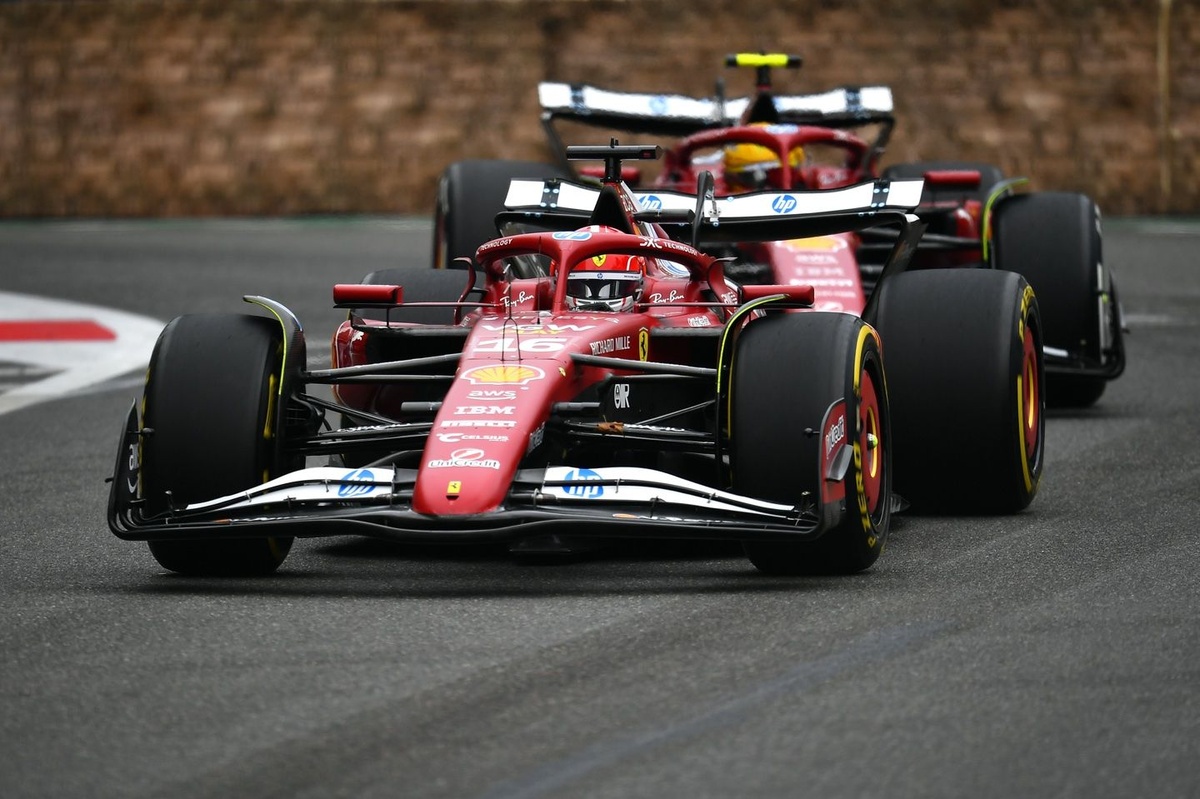
Charles Leclerc’s Frustration at the Azerbaijan Grand Prix: A Closer Look
The Azerbaijan Grand Prix recently had its share of dramatic moments, particularly for Ferrari driver Charles Leclerc. As the race unfolded, Leclerc found himself in a tense battle not just with competitors on the track, but also with the communication dynamics within his own team. The incident that left Leclerc frustrated revolved around teammate Lewis Hamilton and the strategic decisions made by the Ferrari Formula 1 team.
The Race Dynamics: Leclerc’s Position
As the race approached its conclusion, Leclerc was engaged in a spirited contest with Liam Lawson and Yuki Tsunoda for a coveted fifth-place finish. However, the situation took a turn when he was overtaken by Lando Norris from McLaren. At this point, Leclerc was on older hard tires, while Hamilton was equipped with faster medium tires, placing him in a better position to challenge for higher placements.
Ferrari, recognizing Hamilton’s advantageous position, instructed Leclerc to allow his teammate to pass. The reasoning was straightforward: Hamilton had a better chance of advancing past Norris and potentially gaining more points for the team. This scenario is not uncommon in Formula 1, where strategic team orders can often dictate the outcome of races.
The Miscommunication Issue
However, what transpired next was a classic example of miscommunication that ultimately frustrated Leclerc. As the final lap unfolded, he was informed that he would swap positions with Hamilton at the end of the lap if Hamilton could not overtake Norris. Leclerc’s race engineer communicated, "We will swap back at the end of the lap on the main straight if Lewis doesn’t overtake."
Despite this plan, Hamilton did not slow down in time for Leclerc to reclaim his position before crossing the finish line. This led to Leclerc expressing his dissatisfaction with the situation, feeling that the team had not executed their plan effectively. "I don’t really care, it’s for an eighth place, so it’s okay, he can enjoy that P8," Leclerc remarked, frustrated by the lack of coordination.
Analyzing the Responsibility
Upon examining the events more closely, it became apparent that Hamilton was not entirely at fault for the botched swap. His engineer relayed the message to let Leclerc pass quite late in the race. "Let Charles by. He’s one and a half behind you. This is the last lap," Hamilton was told, but by that time, he was already racing down the main straight at high speed.
Hamilton later acknowledged his part in the miscommunication, admitting that he was focused on the cars ahead and did not receive the message in a timely manner. "I was obviously quicker, but Charles was gracious to let me by," he noted. He also expressed his regret about the timing of the message he received, which ultimately hindered their ability to execute the planned switch.
The Bigger Picture: Ferrari’s Performance
While the incident between Leclerc and Hamilton was a focal point post-race, it was merely a symptom of a larger issue plaguing the Ferrari team. The team finished in eighth and ninth places, far from the podium and behind competitors who struggled in their own right. Leclerc’s primary concern after the race was not just the team dynamics but rather the overall performance of Ferrari.
"There are rules that we know we’ve got to work with, and today maybe those rules were not respected," Leclerc commented, hinting at a need for better communication and teamwork. However, he quickly shifted focus to the bigger picture, emphasizing that the team’s lack of pace was the real issue that needed addressing. "P8 or P9… I don’t really care. Obviously, if we are fighting for sexier positions, which I hope will be the case, then I hope that we will work in a different way," he added.
The Implications of Team Orders
The incident raises an important question about the use of team orders in Formula 1. While they can sometimes lead to beneficial outcomes for teams, they can also create tension and frustration among drivers. In this case, Leclerc’s irritation was not solely aimed at Hamilton but also at the team’s inability to effectively manage the situation.
Team orders are often a double-edged sword, and their implementation requires clear communication and timing. If executed poorly, they can lead to misunderstandings that may affect not just individual races, but also the overall morale within the team.
Future Considerations for Ferrari
Moving forward, Ferrari will need to reassess their approach to communication and strategy during races. The Baku incident serves as a reminder that even the most experienced teams can falter under pressure. As the season progresses, it will be crucial for the team to establish more effective communication channels to avoid similar scenarios in the future.
Leclerc’s comments reflect a desire for improvement within the team, particularly as they aim to compete for higher positions. "But I don’t think this should be the talking point. Unfortunately, we have been very slow all weekend, and that’s where we should focus on," he stated, indicating that the priority should be on performance rather than intra-team conflicts.
Conclusion
The Azerbaijan Grand Prix highlighted the complexities of team dynamics in Formula 1, particularly within a storied team like Ferrari. Charles Leclerc’s frustration over the lack of communication and the mishandling of team orders serves as a crucial lesson for the team as they move forward. While the incident was disappointing for Leclerc, it also underscores the need for continuous improvement in strategy, performance, and communication, especially as they strive to regain their competitive edge in the sport.
As Ferrari continues to navigate the challenges of the season, the focus will need to be on both individual performance and team cohesion. Only then can they hope to climb back up the ranks and contend for the titles they seek.
